On co-being, systemic education and what it means to be a part of a system you want to transform
We begin many cohorts of the Young person’s guide to systems change (an introductory programme to systems thinking for social change) with two questions:
“Would you say you are someone who wants to change the world? Or does that phrase make you a little uncomfortable?”
And then, “What makes a person capable of driving change?”
Almost every time, these questions create a lot of discomfort in the room. Some people hesitate because the ambition feels a bit too grandiose, a claim they cannot even imagine taking on, nor do they feel they have earned it. Others hesitate because they have tried to build something or they have participated in many programmes promising change and are frankly worn down by the gap between expectations and reality, or the distance between effort and outcome.
Still others hesitate because they’ve never been asked to place themselves inside a grand vision like that at all. For all, it’s driven by the intuitive understanding that the complexity of systems almost always exceeds our capacity to understand them; that even if we could create a far-reaching impact, it rarely unfolds as we imagined.
What the question is really probing is the separation between the changemaker and everything else, something we rarely examine directly. A chasm, almost invisible, that introduces a dynamic of “us vs. them”. This is an assumption embedded in many leadership and sustainability education programmes: that some people are equipped to transform systems, while the rest live inside them.
Who is on the inside of this work, and who is not?
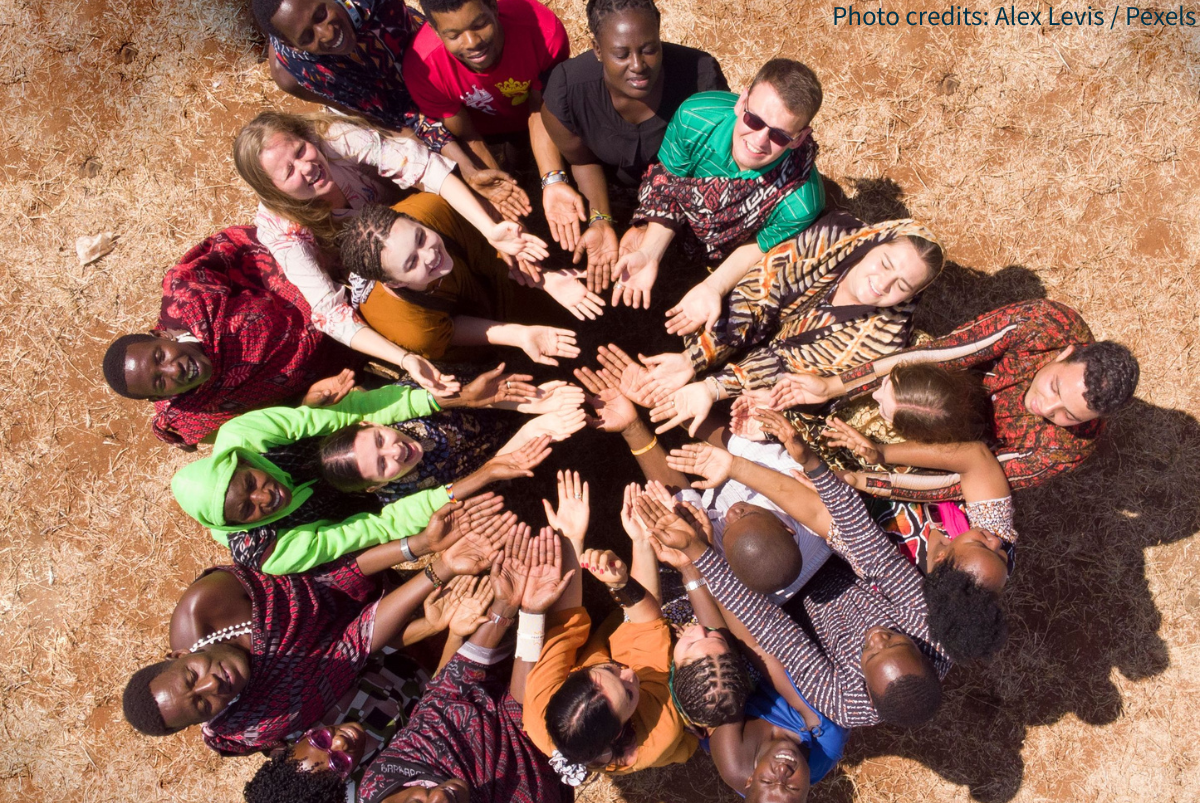
This chasm is not incidental. It is one of the deepest structural problems in how we currently approach systemic transformation. And that is precisely what co-being asks us to undo.
We are ALL the drama
In a 2025 discussion paper, Dancing with Paradigms, we traced this particular gap at the heart of current global crises. It describes the movement from distinction (“I am different from you and other living beings”) to separation (“I am an independent individual”) to the fantasy of exclusion (“I don’t need to care about what happens to you and others”). This is how the gap is made. Not through singular acts of violence but through an accumulation of the logic of an “us” that requires that there must be a “them” to hold that shape.
Them is not always another person. And the intentions are rarely negative. It is often the planet itself in the form of “nature” that we see as something to manage, protect or use. And it is the communities, industries and generations we unconsciously position as the objects of change rather than as actors within the same systems we are part of. In her essay “Situated Knowledges” (1998), Donna Haraway argues that the boundary between self and other, human and nonhuman, knower and known is always a construction.
A construction that serves a particular interest and limits other possibilities. There is often a fantasy view of learning about things from nowhere. That knowledge can be produced from outside the things that make us who we are. It cannot. And this dynamic is precisely what creates this chasm.
Overcoming the chasm, according to Haraway, likely means dissolving the categories of actor and acted upon and learning to think, to act within the mesh of interdependence. Or, dare I say it, Ubuntu. A recognition that you are through the beings around you. Where you stand shapes what you see, and no single standpoint is sufficient for the systemic understanding that transformation requires.
What we’re really asking
This is what our opening questions are really probing. Not how passionate someone is, the size of their ego or whether they are skilled enough. We’re inviting people to begin to locate themselves honestly within a system while recognising that they would like to make a change. Can they see their power and their limitations?
What comes up when the room settles in that honesty is that people then begin to talk about virtues (courage, patience, curiosity, perseverance) and the fact that nothing meaningful ever gets done alone. They start to explore ecosystem thinking. Looking at how a problem in one corner of the system has roots that stretch further than they appear, and how meaningful leverage often requires tending relationships and interconnections.
One workshop cannot teach this, and it often requires community to really dive deep into these dynamics and apply the intentionality needed to learn so we can change. When that happens, we stop waiting to be credentialled as changemakers but as people already holding the relationships that matter, already capable of the interventions that can create ripple effects.
Systemic education to bridge the gaps
This is what systemic education offers that most leadership development/innovation education does not. It is not a tool set for a few but a reorientation for many. A way of understanding oneself as someone who is not separate from the system and thus not completely powerless within it.
The questions asked at the start of every cohort are not rhetorical but are diagnostic. What emerges in its place is harder to name and market, but more realistic and durable. It creates a sense of co-agency that becomes possible when enough people, in enough places, begin to see themselves as part of the same living whole.
That is, as far as I can tell, where hope comes from. The hope that arises when people recognise themselves and each other as already changing the world.
(*) This article was originally published by The Beyond Lab on The Beyond Magazine – Issue 3.