Do you remember the first time you cared about armed conflicts and the impacts of war? Like most of my generation, for me, it was the terrorist attack of 9/11. I can remember the bar where I was sitting when the second plane hit the Twin Towers.
I even remember the channel that the TV was tuned on. I remember it so clearly because it was the first time I was afraid of the calamities a global-scale war could bring.
We know very well that war brings fear. But where does it leave hope?
In 1982, Gabriel García Márquez said in his Nobel Prize acceptance speech for literature:
“The inventors of fables, who believe everything, feel entitled to believe that it is still not too late to undertake the creation of the opposite utopia. A new and overwhelming utopia of life, where no one can decide for others even how to die, where love is truly genuine and happiness is possible, and where lineages condemned to a hundred years of solitude finally and forever have a second chance on earth.”
Have you ever wished for a second chance?
In his powerful words, “Gabo,” as he is known in Latin America, was saying that we need to build a different future where each one of us can dream without boundaries.
But (and there’s always a but) we live in a world where mindsets are fixed on finding nothing but boundaries surrounding us. Terms like “impossible” and “non-viable” are part of our everyday life. This happens because we live in a system programmed to maintain the status quo, leaving little to no possibility for significant changes. To keep dreaming today, we must learn how systems work and how to act to transform them (or how to “dance” with them, in the words of Donella Meadows).
But nothing destroys the possibility of dreaming like war and conflict. Hope becomes a scarce commodity when survival is threatened, and the future becomes uncertain.
For this reason, we need to understand the complexity underlying armed conflicts and violence. To achieve this, we must unlearn what we know about peacemaking and conflict transformation. Traditional theorists and stakeholders of peace and conflict often use the term “conflict resolution.” Many legal documents in this field talk about conflict resolution, as if an armed conflict is a math problem that can be solved simply by adding or subtracting a couple of elements.
However, building peace is a long-term goal requiring more than short-term resource deployment and strategies. It requires deep involvement and commitment from local stakeholders. International coalitions (armed or humanitarian operations) cannot understand the deep roots of conflict in a region and who the key stakeholders and primary actors are that need to be part of the peacebuilding process.
What I am saying is that even if the ‘experts’ are telling you that they know what to do, if they are not taking the time to hear, empower, and involve the local community, things won’t change. Experience shows they will get worse.
The poor results of this approach are scattered all over the world, and we are all aware of them. Nevertheless, so-called experts continue to insist on the same strategies and actions to achieve “conflict resolution.” Maybe it’s time to start wondering who benefits from this way of doing things.
But what can we do?
First, we must be conscious that peacebuilding is not an easy job – it takes time. Time to listen to people and to understand their issues, conflicts, and emotions. It takes time to build relationships with those impacted by conflict, and let them know what lies in your heart and mind, and then you can start a sincere dialogue that sets the foundation for peace.
Secondly, remember that everlasting peace can only be achieved if we all work together. Don’t compete with the people working in the same field as you. Instead, focus your energy on collaborating and building partnerships that bring us closer to the goal.
Finally, believe that peace and a second chance are possible. Because if there is one thing that the current system does every day, it is making us think that we won’t be able to change this world.
Spoiler alert: We will.
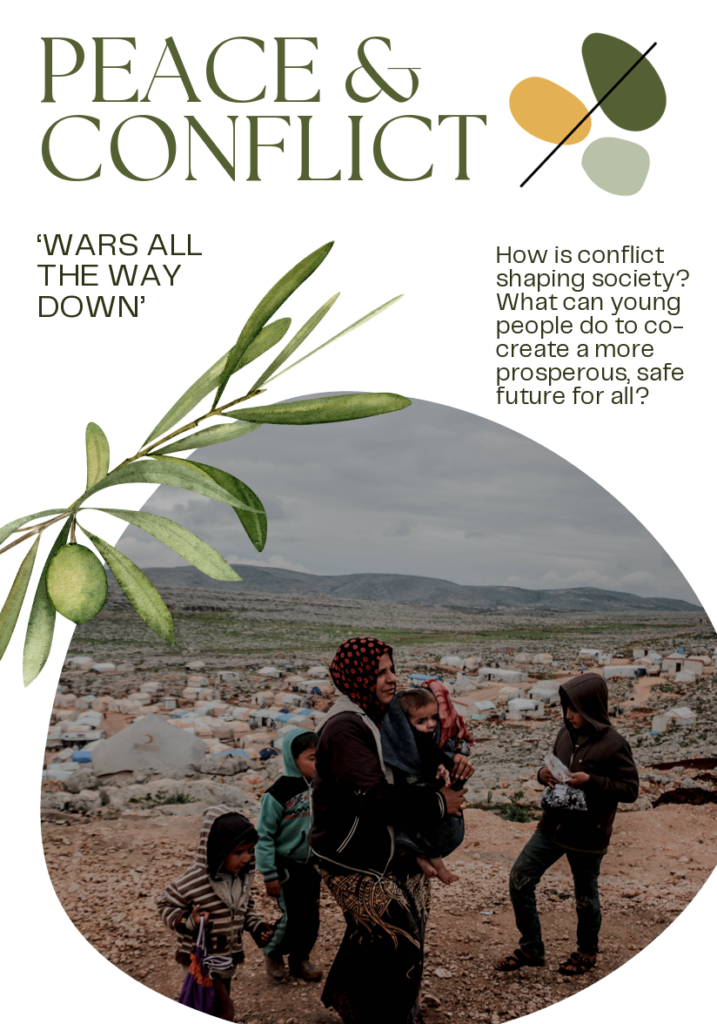
Article by Matías Ignacio Lara: War… war never changes in Peace & Conflict magazine, published by The 50 Percent.
Matías Ignacio Lara, The 50 Percent co-director.