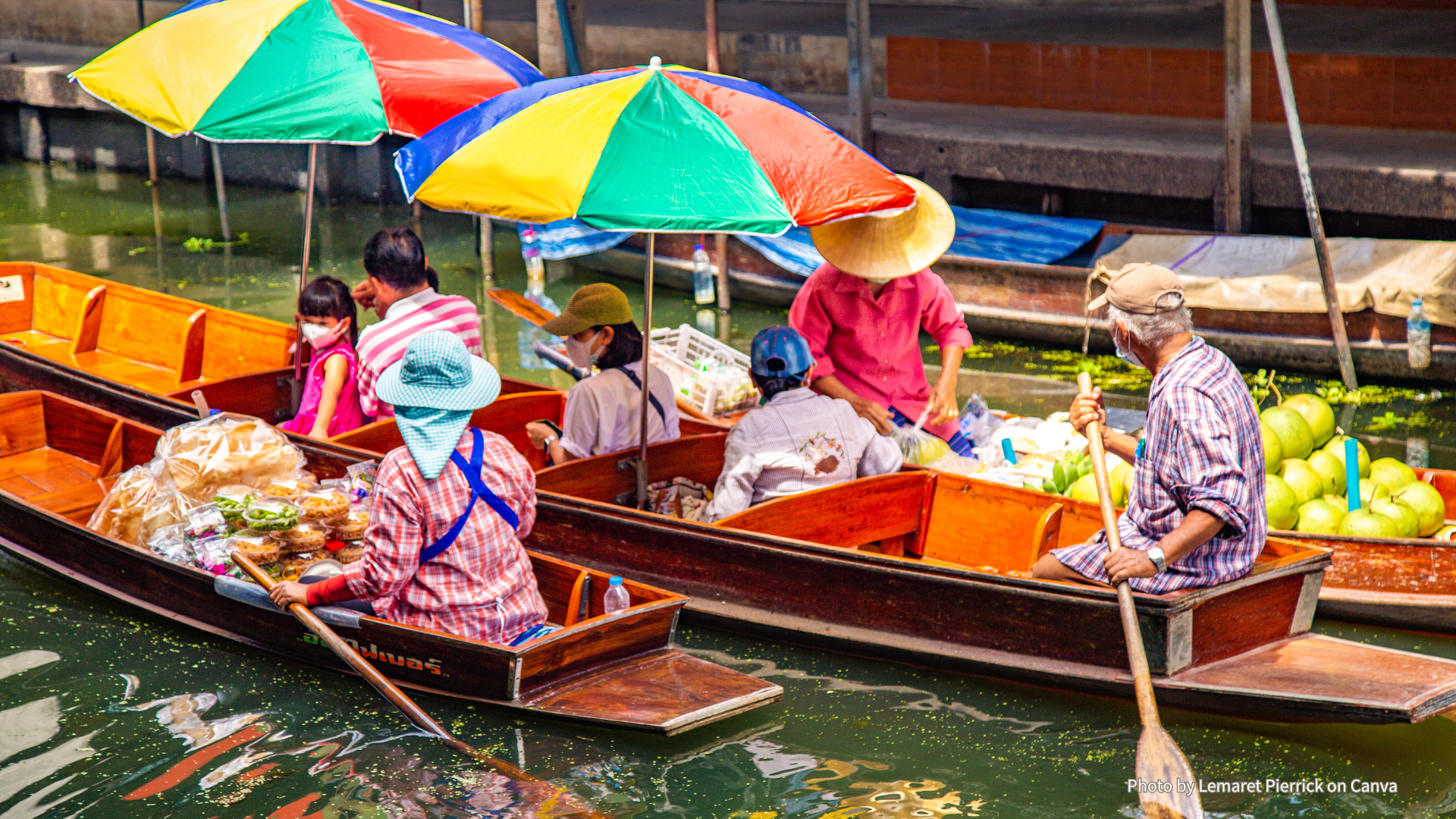
Known to locals as Krung Thep Maha Nakhon, or simply Krung Thep, the city lies between the paddy fields and peaceful towns of Northern Thailand and the beaches and bonfire festivities in the south, which is home to the many beautiful islands that the nation prides itself on. Bangkok itself is a mature cosmopolitan city that never sleeps, with glittering lights and temples, and the beautiful Chao Phraya river cutting through it.
I’ve realised lately that the thing I miss most about home is the spirit of Thai people— a spirit that could be summed up in a commonly heard phrase in Thai, “sabai sabai.”
Ask a man on the streets, “Sabai mai?” (Are you doing well?)
And you’ll hear back, “Sabai khap!” (Doing great!)
Syntactically it’s similar to the French “Ça va?” “Ça va!”, (which means the same as the given interaction) but sabai is a bit different in that it is also a philosophy.
Sabai means relaxation, contentment, and an easy-going attitude towards life. To face life with serenity, positivity, and peace. This is quite possibly why we’re called the Land of Smiles — it’s simply sabai at work.
“When people ask me what I miss most about my hometown, I fail to put it into words. Thailand’s capital Bangkok is often conflated as nothing more than either a hedonist or a backpacker’s dream, in a superficial glance of a city that boasts so much more.”
In my line of work, climate change takes centre stage in our thoughts, threatening to disrupt the range of variables we’ve survived in; pleasant temperatures, a predictable water cycle, healthy crops, few natural disasters, and a sense of comfort, I suppose. All of these are at risk— and with a recent surge of climate denialism (spurred by the goaded lobbying of fossil fuel companies), I’ve seen concerns over climate change manifest as deep-seated worry in young people, as well as anxiety, fear, and anger. All of these are visible in the spirit embodied by young people as they often find themselves doing the work of raising awareness on climate change on the global stage and their local communities — in negotiating rooms, protests, dinner tables with their families, their classrooms, and so many more spaces where young people are pushing the climate agenda forward.
But despite Bangkok regularly featuring on the top ten cities most vulnerable to global warming through rising sea levels, the same manifestation of “eco-anxiety” is not quite reflected here.
This does not mean that climate change is ignored or belittled, (admittedly a hard task when you experience major flooding nearly every year.) Global warming and pollution is definitely a hotly discussed topic, and the Thai government is an active party to the UN Climate Change Conferences (COP).
Thailand ratified the Paris Agreement in 2015 and the Kyoto Protocol in 2002; and climate change is a phenomena that is acutely real in the Thai vision and accepted by the civil society and the government here.
The Thai Nationally-Determined Contributions (NDCs) to the Paris Agreement lay out goals to become carbon neutral by 2050, laying out the fragility of the country and the steps needed to develop in a sustainable manner.
In fact, the late king HM Bhumibol Adulyadej, Rama IX’s theory of the “Sufficiency Economy Philosophy,” a formal conceptualisation of sustainability and effective resource usage juxtaposed with the Thai sabai philosophy, is also highlighted as a strategy in Thailand’s submission to the UNFCCC. The “Sufficiency Economy Philosophy” encapsulates moderation, prudence, resilience, and the middle path in life, following on from Buddhist teachings.
The government itself has a lot of work to do to ensure effective climate action, from retrofitting an ageing national grid with poor connection in certain regions (we are still a developing country!), to phasing out coal and gas in favour of renewables without tampering the balance between growth and climate commitments. Still, the nation accounts for less than 1% of global emissions but will be one of the first to feel its brunt.
There have been a spur of innovative ideas in Bangkok to combat its impending fate, like the brilliant “Porous City” project, by my favourite architect, Kotchakorn Voraakhom, that includes a park in Bangkok that absorbs excess runoff water. Her TED talk on the matter is a masterpiece — she conveys a problem, and offers a solution with a smile. This to me exemplifies sabai; grace and resilience in the face of challenges.
Ahead of COP28 countries race to evaluate the Global Stocktake, which is, in simple terms, a measure of progress in climate action for the whole planet, rather than a country-to-country basis. As countries convene and negotiate over goals, there will also be an exchange of ideas and attitudes. The sabai attitude and a moderate way of thinking has been enshrined in the Thai NDCs, and one can hope that a similar idea of restraint, moderation, and sufficiency can inspire other countries to consider sustainability as being more than a political tool. It’s a philosophy and a way of living; just like sabai.
There’s no way to predict when Bangkok may face its watery fate. Perhaps the city will gracefully return to its roots, navigating its waterways like the boats that gave birth to the famous kuay tiew ruea (Thai boat noodles). What remains certain is the unwavering resilience of our people — the Thai spirit of sabai sabai. We will find a way to manage the inevitable flooding of Bangkok, always with a smile and an innate adaptability. It’s in this spirit of resilience, amidst the uncertainties of climate change, that we find hope.
In the words of an ancient Thai proverb, “กุศลมีลูกมีกลู” (Guson mee look), or “goodness has children” – a reminder that our good deeds ripple forward.
Article by Tanvi Mishra: ‘Sabai Sabai: The Unsinkable Spirit of Bangkok’, in Youth Voices in Climate Resilience, published by The 50 Percent.
Tavi Mishra is an environmental economist (MSc, Durham) working at the intersection of climate risk and finance, with experience in the United Nations system under the IPCC Vice-Chair.