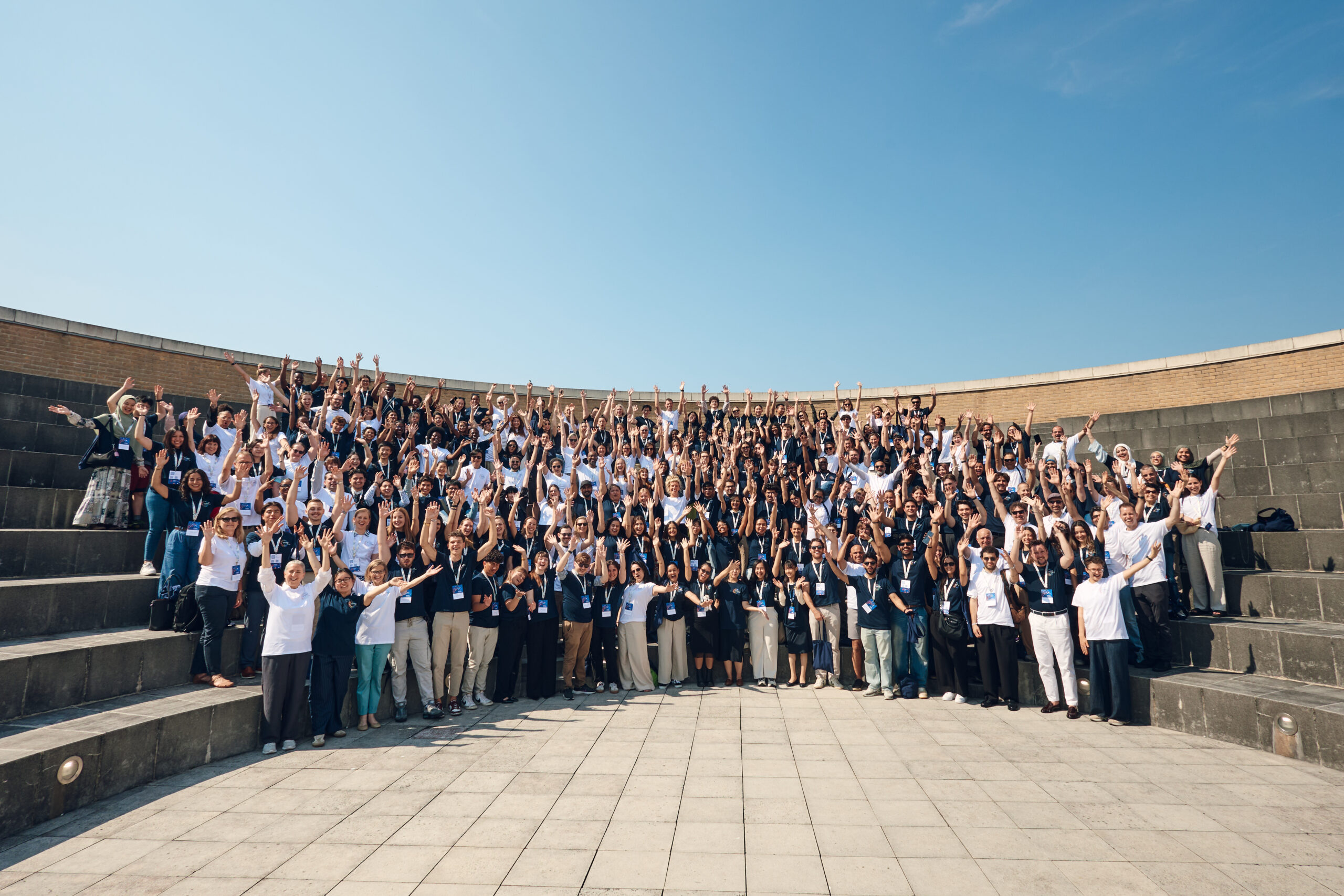
Participants of the 2026 Map The System Global Finals at Said Business School, University of Oxford.
I still remember learning about pollution and the impending danger of climate change while growing up in a rural home. It was all real to me. Raised in a mostly arid and semi-arid area, I saw mules long before I learned the word for them, since they were the only way to get water to our homes, gardens and schools. The crops did terribly, and the livestock, feeble and malnourished, joined us in appeals to the gods for mercy on our land. It was during times like these that my grandfather daydreamed a lot. Lamented, rather. It was exasperation, nostalgia and longing for better times, and it broke him that his once-strongest bulls would not be pulling the plough the next farming season, because they now belonged to someone better able to keep them alive. There was not going to be a farming season.
There is no single-issue struggle
Things had not always been like this. I knew there was a problem somewhere, and the prayers held out only as much as hope did. It wasn’t just the animals dying from hunger. Families too struggled to make ends meet, fell apart under growing violence and many children could not afford to attend school. Education suffered, and then hospitals were overwhelmed. It was all a ripple effect. Later, when I learned to read better, I discovered that most of these issues I witnessed growing up were interconnected and that there have never been single-issue struggles.
In control engineering, we are taught that parameters are the fixed or tunable values we study to understand the patterns and trends of a mechanical or automated system: constants that shape behaviour without changing the system’s underlying structure. Feedback, on the other hand, involves taking a portion of a system’s output and routing it back in as input to alter future behaviour, as in a thermostat sensing room temperature and adjusting the heater in response. Structural accumulations are often represented in stock-and-flow diagrams, where valves and pipes indicate the inflows and outflows governing how much builds up in a system over time. There was pre-existing language for systems, some of which found its way into systems thinking to explain complex social issues.
This work has always been personal.
On the night of March 6, 2026, Nairobi was hit by heavy rains. In minutes, the whole city had turned into a swamp, and for over four hours, cars and people were stranded while others were swept away. In Grogan, downtown, where the mechanics and spare-parts dealers often keep their yards, dozens of vehicles were dragged away by the current. People clung to the rooftops of submerged cars and waded through water so high, while power lines came down and whole estates went dark. By the weekend, police were counting drownings and electrocutions, and by the time the water finally receded, the city had counted sixty-seven of us who didn’t make it home that night.
Looking beyond the band-aids
There is a drainage problem in Nairobi. In the tragic aftermath of those floods, we all looked at management and urban planning for answers, and perhaps some accountability. But it turns out this tragedy was a direct result of Nairobi’s waste crisis, far bigger than the band-aid of waste sorting and management. I have always wanted to understand why, despite the city being rife with waste-management campaigns and circular-economy start-ups, the problem keeps worsening, especially in low-income neighbourhoods. In April, we set out on a journey to understand this crisis. I, as a fellow of The Sparks Impact Fellowship, paired up with two teams from Georgian College and Via University College, in Canada and Denmark respectively, courtesy of the Global Polytechnic Alliance (GPA), of which The Sparks Impact Fellowship is part. Little did we know this journey would not only rewrite our beliefs and views about the world but also change us as individuals.
The Dandora dumpsite is as vast as it is dense: hair caught on ragged bottle parts, rows upon rows of pale plastic, chunks of braids, rusting metal sheets and the deplorable feel of wet ground underfoot. The smell announces itself with a threatening dominance; even camphor wouldn’t stand a chance at detaching it from one’s scent memory. On a normal day, hundreds of children as young as ten spend their days scaling mountains of smoking garbage. Unprotected, they scavenge through toxic waste for plastic, scrap metal and at times food.
Every story we documented, of a mother who had borne the burden of losing a child to illness, and of every child whose dreams had been paused for survival, had to do with some form of incomprehensible loss. Violence, exploitation, sexual abuse, harassment, not to mention the daily exposure to hazardous waste. Everyone we met somehow knew somebody who had lost a limb, or a home nearby they could no longer return to. Or they themselves had lost something, someone. Young men and women who once dreamed of changing their circumstances have instead been met by the unforeseen fate of scavenging. Most days, the sun is too hot for warmth to feel like a simple thing, and they have had to pay for their survival with those very dreams. Their fight feels futile against a problem they consider as rigid as rigor mortis, and while the situation is dire and people can reasonably empathise with their struggles, not many solutions have offered real help, beyond turning the place into a site to reckon with and make headlines from.
Like my mother’s iconic flu concoction recipe, I memorised each of their pains. It was sad and then I caught this lump in my throat that I could not shake off for days. Just listening would not suffice. There was work to be done, and yet I could not fathom ways to translate such heaviness into comprehensible language for a new audience, knowing these communities deserved so much better than our shaky voices. When we set out, we did not know how important this work would be, until we met the people so often reduced to statistics in publications, facing the scourge of unmanageable waste. The more we sought to understand the system, the more it felt insurmountable, because of how deep it ran. This was not solely a Kenyan problem, but a direct result of wealthy nations maintaining high-consumption lifestyles by offloading toxic garbage onto the Global South, turning sovereign land into sacrifice zones where local health is traded for global profit. Our sole responsibility was to tell the stories as raw as they were and translate this system to a global audience. How much could we cover of years of historical inequalities within the global order, in just ten minutes?
Collapse travels across borders, so must solidarity
We got to the global dais, shared the space, and realised many people across the world are facing the same collapse, from similar crises and that the weight of fragmentation can be felt everywhere. We shared learnings with deeply passionate young people pushing through one issue at a time, from mental health to artificial intelligence use, agriculture and ecosystems, forests, health and surveillance, to mention a few. Suddenly, we felt connected to the world. When we got on stage, we felt like we could flip the page in those ten minutes. We shared stories of resilient communities, in Dandora and across the world, pushing back against total collapse. Frantz Fanon wrote that “each generation must, out of relative obscurity, discover its mission, fulfil it, or betray it,” and I cannot help but feel young people in this moment are actively holding the line, healing and remediating.
Remediating is reparation, repairing the relationship between the land and the people, between those who discard and those who are made to receive. It is restoration. Reparation is the ongoing practice of returning dignity, agency and futurity to communities long treated as disposable. Reparation is deliberate repair, memory and the slow return of belonging to colonised people. It is the collective work of solidarity and power redistribution.
Documenting and telling these realities has been the pinnacle of understanding and translating the waste crisis as a systemic issue, with the hope that our conscience nudges us towards accountability. And when you, a systems changemaker, find this systems change work, I hope you never walk alone. I hope it becomes a reminder that we have never needed the world or our conditions to be perfect to keep the hope alive. The hope that things could and would be better. And then we will love that hope so much through fragmentation, because something loved cannot be lost. We cannot be lost.
Oh, to be humans of this world.
[Read our research summary entry for the 2026 Map The System Global finals here]