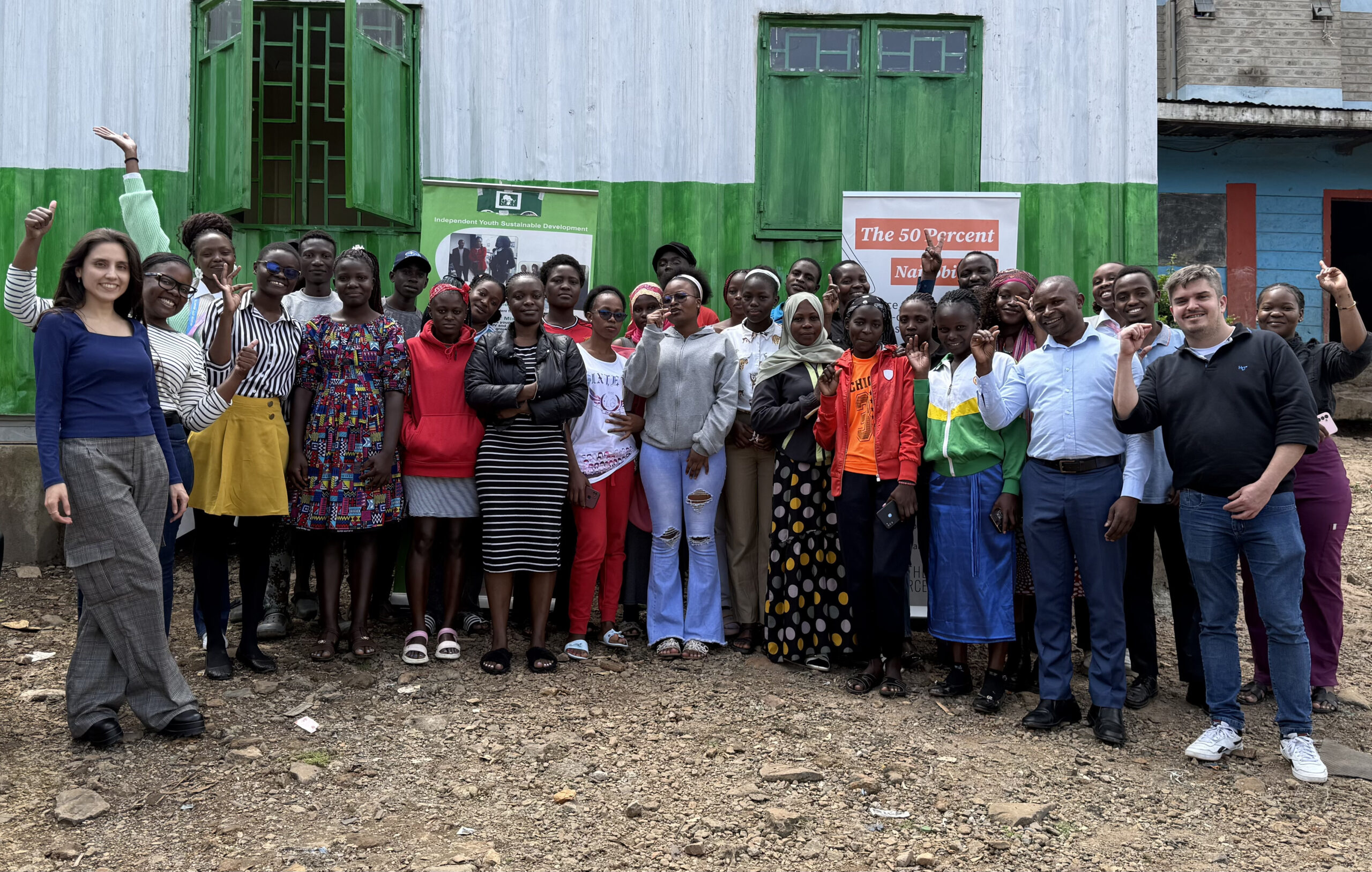
In partnership with DAY Africa (Development Associates for Young Africans), The 50 Percent has brought the Young person’s guide to systems change to Kibera, where fellows are exploring how systems thinking relates to the realities around them and what meaningful governance and leadership look like in practice. Known for its creativity, urban culture, sports and socio-political consciousness, Kibera offers a relevant setting to explore these ideas.
Building a partnership
Since May 2026, young people in Kibera have met once a week to explore how people, rules and habits interact to sustain complex challenges. These sessions form The 50 Percent’s first Kibera cohort, delivered alongside DAY Africa, a youth-led nongovernmental organisation working in Kenya’s informal settlements and rural areas.
The collaboration began when Matías Lara, co-director of The 50 Percent, and Solomon Odero, founder of DAY Africa, met at the Club of Rome’s Intergenerational Dialogue Forum in Costa Rica in December 2022 and recognised the overlap in their work.
DAY Africa has been running youth programmes since 2018, including initiatives focused on economic empowerment, sustainable livelihoods, health and gender. The organisation has trained thousands of young people across Kibera, Mathare and Korogocho. Through this partnership, The 50 Percent provides the curriculum and facilitators, while DAY Africa hosts the sessions and connects the programme with young people already participating in its courses.
Rather than building new structures from scratch, the approach is to work with organisations that young people already know and trust, bringing new learning opportunities directly into their communities.
A co-learning space
Most fellows have recently completed secondary school, while the oldest participants are in their mid-thirties. From the beginning, they have played an active role in shaping the programme, contributing personal experiences and community perspectives that enrich each session.
“Learning alongside peers with different experiences and perspectives has challenged how I think and given me people to grow alongside,” says Wycliffe Okoth, a Cohort I fellow.
The weekly sessions run for at least six weeks and introduce participants to reading and mapping systems, identifying connections and recognising points where small interventions can lead to significant change. The curriculum also explores virtuous citizenship, advocacy, storytelling and dialogue.
Is anyone really a villain?
The first session, focused on virtuous citizenship, sparked a debate that has since become a recurring feature of the programme. Facilitators introduced the idea that the systems in which people operate shape their behaviour, challenging the notion that individuals alone are responsible for systemic problems.
Some fellows strongly disagreed, arguing that certain actions reflect individual moral choices rather than the structures surrounding them.
Similar discussions have emerged across Nairobi hub cohorts, raising a central question: where should responsibility lie, and where should efforts for change be directed?
If people see corruption solely as the result of individual wrongdoing, replacing those responsible might seem like the solution. But when the same patterns persist under new leadership, it becomes necessary to examine the structures that allow them to continue.
The discussion is not about reaching a unanimous conclusion. Instead, it encourages fellows to consider how personal values, individual responsibility and systemic conditions interact, and how these can contribute to meaningful transformation.
Mapping the house you live in
One of the most engaging sessions introduced fellows to systems mapping through an issue closely connected to their daily lives: housing.
Kibera is one of Africa’s largest informal settlements. The 2019 census counted about 186,000 residents in Kibera, though other estimates run far higher, and virtually almost no resident holds title to the land beneath their home.
Using Kenya’s housing programme as a case study, fellows examined its potential implications for their community. They raised questions about displacement, affordability and land ownership. Who would need to relocate to make way for new housing units? How do the proposed prices compare with what residents can realistically afford? Who owns the land?
These questions led to a deeper examination of the relationship between a system’s stated objectives and its actual outcomes, including who benefits from existing arrangements.
Rather than providing predetermined answers, the exercise equipped participants with a method they can apply to other issues affecting their communities, from access to water and public transport to county budgets.
From protest to proposal
For many young Kenyans, challenging established structures is not an abstract concept. In June 2024, youth-led demonstrations against the Finance Bill brought thousands into the streets, with young people using digital platforms to analyse proposed legislation, translate information into local languages and mobilise public participation.
As Judy Mbugua discusses in her article “Why Kenyan Gen Z Have Taken to the Street”, published in the Journal of Democracy, this mobilisation reflects a generation increasingly determined to participate in civic discourse and influence decisions affecting its future.
The programme recognises protest as a form of civic engagement while encouraging fellows to explore complementary approaches, including public participation, dialogue and identifying opportunities for change within existing structures.
Throughout the sessions, participants have consistently connected these lessons to leadership. They recognise that leadership is not limited to formal positions and that the ability to influence their communities begins with their own actions.
“One of my biggest takeaways is that systems thinking is not just academic. I learned that young people don’t have to wait to be handed leadership positions. They can take individual responsibility and build from wherever they are,” says Everline Obushuru, a Cohort I fellow.
Her reflection captures an important aspect of the learning experience: recognising that young people already have the capacity to contribute to change, while developing the skills to understand the wider structures in which they act.
Building on what already works
The Kibera cohort demonstrates what can happen when organisations combine their experience, resources and community connections around a shared purpose. By working through an established local partner, the initiative has created opportunities for young people to explore complex challenges and develop practical tools to address them.
Looking ahead, The 50 Percent and DAY Africa hope to strengthen their collaboration through alumni forums that allow former fellows to remain connected, exchange experiences and continue learning together. Future cohorts will build on this foundation, extending opportunities for systems literacy and community-led transformation to more young people in Kibera.
This article gives the views of the author(s), and not the position of The 50 Percent and or its partners.