
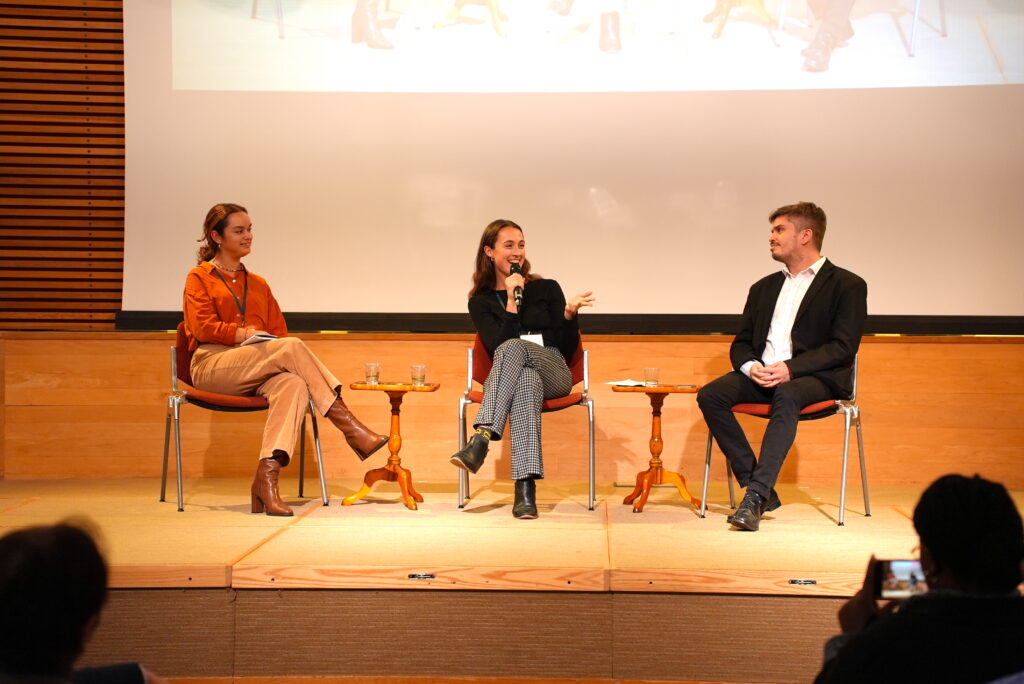
 Vanessa Terschluse, Kristen Miller and Matías Lara facilitating a workshop during the “It’s Time for a Human Revolution” event at Taplow Court, UK.
When it comes to creating change, storytelling is often dismissed – it is emotional, ineffective, even frivolous. But in the world we’re living in today, storytelling is one of the most powerful tools we have to rebuild connection in a fragmented world, to counter misinformation and to catalyse the kind of systems our generation urgently needs.
The stories we tell and listen to are determining the future more than policy papers or election cycles ever could. They shape who we trust, what we fear and ultimately, what we believe is possible.
In a moment defined by polarisation and information overload, storytelling is not a soft skill. It is a tool of democratic resilience. One of the last remaining ways we can still lean across the table and reach out for someone else’s hand.
We now live in an ecosystem where roughly one in five TikTok videos contains misinformation. Fear spreads faster than facts. Outrage is engineered. Identities are weaponised. But contrary to what we often hear, misinformation doesn’t thrive because people are foolish. It thrives because it tells simple, emotionally gripping stories about a complex world – and because too often, our political leaders and our calls for systems change don’t tell a story at all.
A healthy society needs more than policies. It needs narratives that help us hold complexity, that make space for ambiguity without collapsing into hopelessness. As our Young person’s guide to storytelling argues, good stories don’t flatten the world into “good versus evil”. I love stories because they remind us of our humanness, and bring evidence to my favourite thing to say (as my 50 Percent colleagues will know very well): two things can be true at the same time.
Systems do not shift because we diagnose problems loudly. They shift when we name shared values clearly. When climate action is framed as a battle between economic survival and environmentalism, we reinforce divides. But when we tell stories about communities rebuilding dignity through green jobs, restoring land or safeguarding future generations, something changes. We activate the values that cut across ideology: care, community, justice and a sense of belonging. Shared values are not a soft entry point. They are the foundation of systems thinking and systems change.
When we centre the storyteller, we change the conversation
There is transformative power in simply listening to someone’s lived experience.
When young people talk about the emotional toll of online hate, when migrants describe the meaning of “home,” when elders share how climate change has altered ancestral lands — defenses soften, and new ways of seeing become possible.
In an era where political actors profit from fear, these stories destabilise the narrative architecture of division. They humanise what has been polarised. And they invite us into a conversation grounded not in winning, but in understanding.
Hope, reimagined
In an age of institutional distrust, young people across regions increasingly believe that their democracies are not delivering. But telling stories of despair does not build power. Only stories that illuminate agency do.
Hope today is often dismissed as naïve, but it may be the most strategic resource we have left. Stories that highlight agency, possibility and solidarity widen our sense of what can happen next. They create the emotional conditions for action. And hope is contagious. It spreads just as quickly as fear – we only have to dare to create it.
This is the central idea of our guide. Storytelling isn’t a luxury. It’s an essential tool of democratic resistance and transformation.
If we want to counter polarisation, push back against the tide of cynicism, and reclaim our collective future, then we need to tell better stories: stories that bridge divides, spark curiosity and rebuild our sense of shared belonging.
This is why storytelling matters today.
This is why it matters for systems change.
And this is why we – especially young people – must practice storytelling and devote our time to it as if it is going to radically change the world. Because it is.
This article gives the views of the author(s), and not the position of The 50 Percent and or its partners.